

In 2017 Didcot was named the most ‘normal’ place in the UK. According to the statisticians that crowned the railway town, Didcot is the closest to the national median lifestyle when you consider age, vote, income, ethnicity, employment levels or house prices. But many people in Didcot are involved in something that is anything but ordinary.
Just two miles away the Harwell science and innovation campus is home to more than 7,500 jobs working at the cutting edge of science. Harwell started as the home of the UK Atomic Energy Authority and now is home to a dazzling array of new cutting edge science projects1.
The facilities in Harwell include Vulcan, which is currently being upgraded to become the world’s most powerful laser. When it is finished each pulse of light from the laser will use six times more energy than the rest of the world combined, though only for less than a trillionth of a second. But even the trillionths of seconds add up.
At the ISIS Muon and Neutron facility nearby, a single experiment uses the same amount of electricity as seventeen British households use in a year2. In 2011, the cost of electricity was around 15% of the annual operating budget and rising. The graph below shows how the cost of an experiment’s energy has risen since then - with the price more than tripling in the last fourteen years.
Over the summer, science cuts were in the news, most notably because of Jodrell Bank Observatory, which is facing the axe after UK Research and Innovation (UKRI) announced they would withdraw funding. But this isn’t because UKRI has had its own funding slashed - in fact they were able to dedicate an extra £135m cash injection to the Science and Technologies Facilities Council.
The threat to Jodrell Bank, the Diamond Light Source, and Harwell’s Isis Muon and Neutron Facility isn’t short-sighted bureaucrats or penny-pinching politicians. It is science getting more expensive. When questioned by the Science and Technology select committee before summer recess, the chair of UKRI explained that there were three main reasons that the cost base for scientific projects was rising; rising inflation, a weakened pound against foreign exchange rates, and an overly ambitious number of projects.
Too many projects is one thing, but the first two reasons could really just be condensed into one: rising energy costs. It’s one of the primary drivers of inflation in the UK, and importing lots of very expensive energy contributes to a weakened pound – Britain’s net energy import bill went from around £9 billion in 2019 to £45 billion in 2022, worsening our terms of trade3. One of Andy Burnham’s first interventions in parliament as Prime Minister was to reminisce about a school trip there and vow that “there must be a way to save Jodrell Bank, and [...] we will find it.”
More money for science will always be welcome, but what facilities like Jodrell Bank and Harwell really need is cheaper electricity. The best way to do that is to build more electricity and increase the supply. Fortunately, there’s a project just 12 miles away from Harwell that wants to build more than 840 MW of capacity, made up of renewable energy, in a region of the country where polling found 70% of people would be willing to support a new solar farm being built near them.
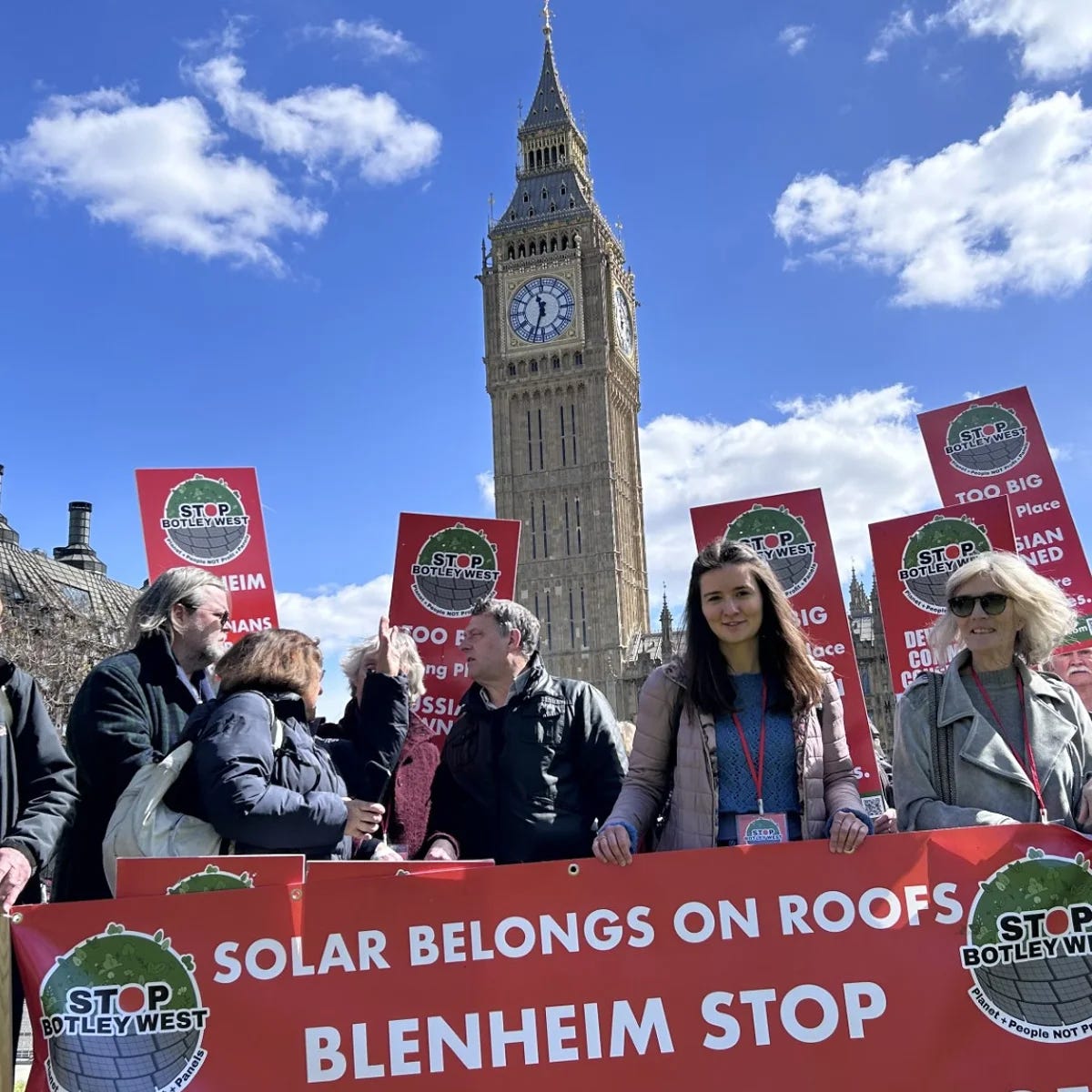
Unfortunately, that project is Botley West. Botley West is a Nationally Significant Infrastructure Project (NSIP), meaning that the Secretary of State gets to decide on whether it should be built. The Secretary of State has recently asked for more information and in April delayed the final decision on the project. That deadline will now be on the 10th November4 and will be one of the first tests for the new Burnham government of whether they are prepared to make potentially unpopular decisions for the good of the wider country.
This is after nearly four years of planning consultation and applications. The company behind Botley West now says that the planned switch on date will be in 2029, seven years after the planning process first began. The worst thing is that only about twelve months of this is likely to be actual construction, everything else will have been the planning process and consultation for a project that should have avoided the worst of Britain’s planning system.
But Botley West is very large, and very controversial. There were (largely unfounded) questions about Russian ownership and the loss of farmland (meeting Britain’s 70GW solar target would require just under 1% of Britain’s total farmland).
So maybe there should be smaller sites that generate less energy but work directly for our important science projects. Maybe they should be sensitively developed by known and reliable energy companies and be careful to minimise disruption to local residents and wildlife. Surely that sort of a project would be well received?

In 2022, around the same time Botley West started their planning process, UKRI also applied to establish a Power Purchasing Agreement (PPA), worth £46 million to build a 15MW solar power site on a field, owned by Rutherford Appleton Laboratory, part of the wider Harwell campus. This was won by EDF in 2023.
But, three years later, the PPA hasn’t even started the formal planning application process. The pre-assessment work is done and residents have been informed but the official application process is not yet on the Vale of White Horse council website. In theory, the application ought to move swiftly once it does appear. But as we all know, the course of the British planning system never did run smooth. Angry residents, (and early posts suggest there will certainly be some angry residents) could mount delays and appeals for this site. UKRI are doing all they can to bring this PPA online, they own the site, which borders the facility, they’re using their own money and have already done what they can to boost electricity production on the campus, but it is still not enough.
Didcot is still a pretty normal town. But this coming year some of its residents could be laid off because of one of the most normal things in Britain today: cripplingly high energy prices, and a planning system too slow to beat inflation. It doesn’t have to be this way. Harwell first became a science hub after the Second World War, when an abandoned airfield became the site of Western Europe’s first nuclear energy reactor. It took just over a year. It has taken its successors over three to apply for planning permission in a field it already owns. If the prime minister really wants to do whatever it takes to save Jodrell Bank then he ought to start making it easier to power our scientific projects.
Calculated from the figures in Challenges of reducing energy consumption at ISIS and average household energy figure taken from Ofgem (2026)
It also led to a large increase in Government borrowing as politicians attempted to shield the public from the worst of the gas crisis, which in turn weakened the pound.
A previous version of this post said that the decision will be published on the 10th September which was true at the time of drafting but technically untrue at the time of publishing as it had just been delayed AGAIN. No real guarantee that it will happen in November either.
I used to work at Harwell, when it was the AERE. The cooling towers of the Didcot power station on a summer day with no wind were a sight to behold: a vertical column of condensed steam rising up as far as they eye could see. Culham, nearby, used to take 100% of the output of that station to run a fusion experiment. We all believed that fusion power was the future. Maybe it still is.